International Conference on Good Governance and the Built Environment of Late Medieval Cities (ca. 1200-1700)
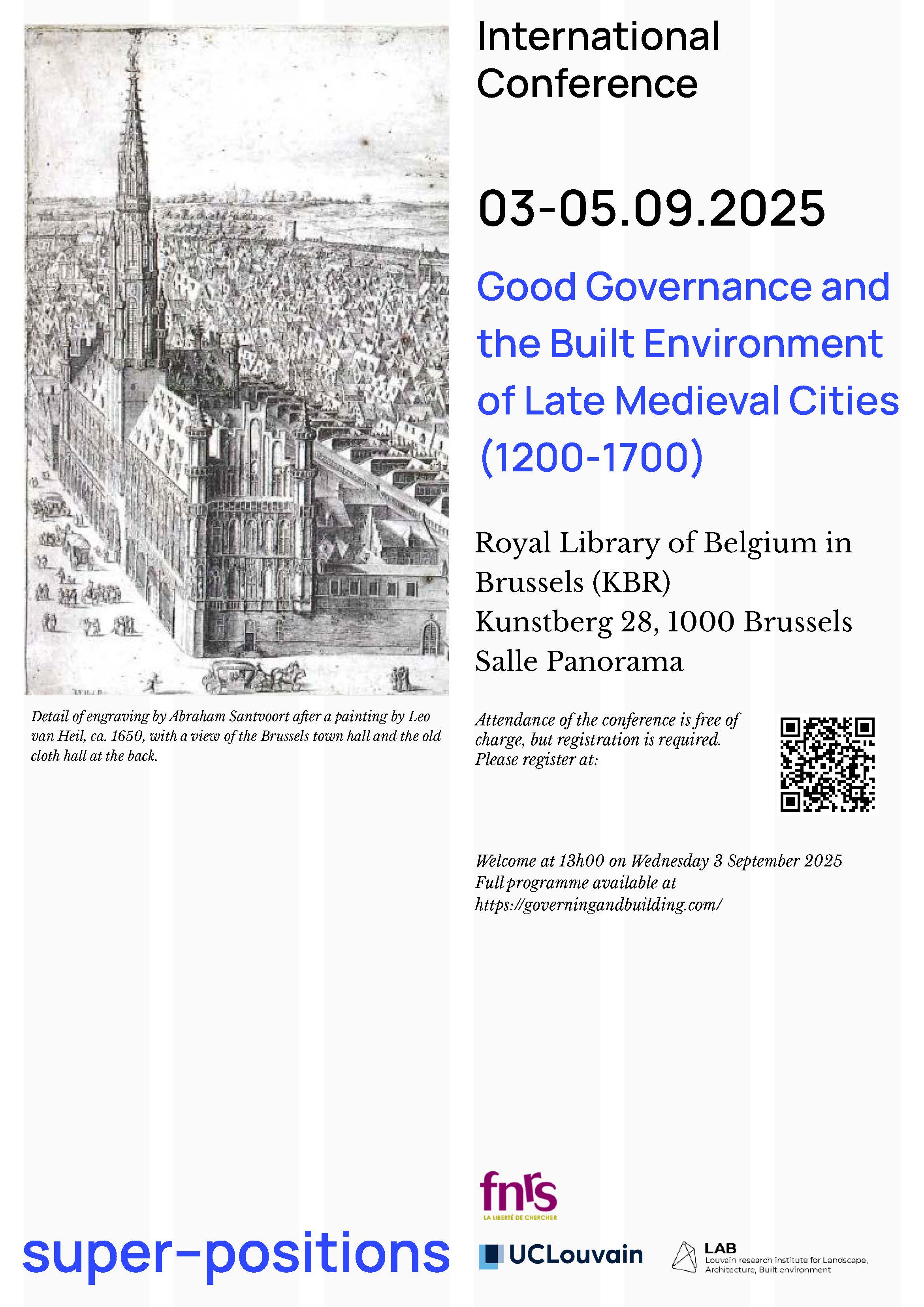
In the late Middle Ages, cities were governed through constant dialogue. Rulers, nobility, citizens and other social groups all found ways to shape urban governance, each articulating complex views on what “good” governance entailed. In order to meet expectations of justice, protection, economic welfare, and the common good, all the aforementioned individuals would often invest in the city’s built environment, either by initiating new architectural and infrastructural projects, or by securing the maintenance of existing ones.
The city as a built space thus required constant development, and in this upkeep and expansion, rulers and governors were attributed a specific responsibility. Scholarship has already extensively explored various policies initiated by rulers and governors for the construction and maintenance of the city’s built environment; Previous studies have, for example, drawn attention to the governmental structures set up in late medieval cities or have explored the legal measures implemented to control urban environments. Similarly, scholarly attention has also focused on individual architectural and infrastructural projects initiated by rulers and governors as a means to meet expectations regarding their governmental responsibilities. However, a systematic overview of how these tasks and obligations regarding the built environment of the city were linked to ideals of good governance is missing, as well as the scope to set individual cases within an overarching framework.
This conference seeks to address this lacuna by asking specifically how the built environment of late medieval cities was conceptualised and physically shaped in relation to ideals of good governance. The focus will be on urban centers in diverse geographical regions (from North-Western Europe and the Mediterranean to the Middle East), and this in the period of 1200 to 1600.


.png)
